
 +52 33 3817 0140 | +52 33 3817 8122























Return to Hardness Testers and Accessories ← Future-Tech Hardness Testers← Microhardness Testers | Vickers Hardness ←
Vickers and Knoob FM-810 Hardness Testers

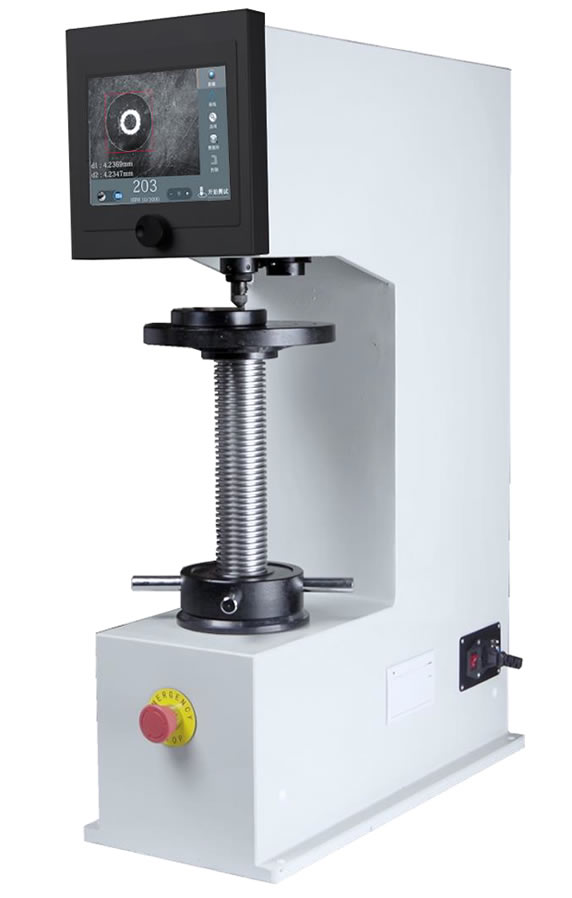
The FM-810e and FM-810 Series perform precise measurements of Vickers (HV), Knoop (HK), Brinell (HB), and fracture toughness (Kc) quickly and easily, with one-touch selection via the touchscreen panel.
.
USB OUTPUT
- Equipped with a USB port for data output, along with cylindrical/spherical compensation and sample thickness calculation functions.
ADVANCED COLOR LCD TOUCHSCREEN DISPLAY AND OPERATION.
- Color LCD touchscreen panel integrated with a highly advanced PC board.
- Measurement procedures, conditions, and data are clearly displayed. (FM-810 Series)
.
BRINELL TESTING
-
Accurate low-load Brinell testing is available as a standard function.
-
An optional accessory, “Ball Indenter φ1 mm,” is required. (FM-810 Series)
.
FRACTURE TOUGHNESS TESTING (Kc)
- Kc values can be measured as a standard function according to the JIS R1607/IF method.
- Combined with Micro Vickers and Knoop values, it is highly effective for evaluating new material quality. (FM-810 Series)
.
CLEAR VIEW AND EASY MEASUREMENT
- A newly developed illumination system with interchangeable aperture diaphragm and field aperture provides enhanced resolution at both high and low magnifications.
- Easily replaceable color filters further improve image clarity. (All series)
.
WIDE RANGE OF SELECTABLE TEST LOADS
- Test loads can be freely selected from a wide range, allowing customized load combinations. (Optional / configurable).
.
X-Y COORDINATE DISPLAY
- Stage coordinates are displayed on-screen when linked with the optional digital micrometer head.
.
4 OBJECTIVE LENSES (OPTIONAL)
-
The new turret mechanism supports up to four objective lenses, enabling observation of a wide sample area.
-
Different magnifications can be easily selected by rotating the turret.
-
Proper objective selection ensures more precise and repeatable indentation placement and measurement. (FM-810 Series).
.
2 INDENTERS FOR HV/HK MEASUREMENTS (OPTIONAL)
- The new turret mechanism allows two indenters to be mounted simultaneously.
- Enables Vickers and Knoop testing without changing the indenter. (FM-810 Series)
.
 (Agrandar)



















 ¡Welcome!
  WhatsApp,
  leave us a message on the fixed
  Chat icon.


